
Blog

In the early 90s, Worthy Wage Day was established by teachers and advocates as a way to annually celebrate early educators and the important jobs they do, to lift up their voices and to call communities to action on their behalf. The goal was — and still is — to raise awareness of the field’s low wages and to ensure that the value of those working with our youngest children is recognized.
The fact that we still need this day speaks volumes. Despite efforts made in response to the COVID-19 pandemic to stabilize early childhood, including grants that were used to increase compensation, the field is still underpaid, particularly given what teachers must know and be able to do to help our children succeed. Science makes clear that brain development is at its peak in the first five years, making the job of our early educators one of the most important for individual life outcomes as well as for the health of future communities. Early educators are the workforce behind the workforce, making it possible for parents to go to work while also nurturing the next generation.
So why is the profession still undervalued?
Early childhood is what many call a “market failure.” Parents simply cannot afford to pay what high-quality care really costs, and childcare programs can’t afford to raise prices without driving families away. As a result, teacher pay remains low.
According to the Early Childhood Workforce Index 2024, a report by the Center for the Study of Child Care Employment, early educators nationally earn a median hourly rate of $13.07. The study goes on to say, “Everyone working with young children should earn at least a livable wage, which is higher than current minimum wage levels. Yet, the median early educator wage in every state falls below a living wage for a single adult with no children.”[1]
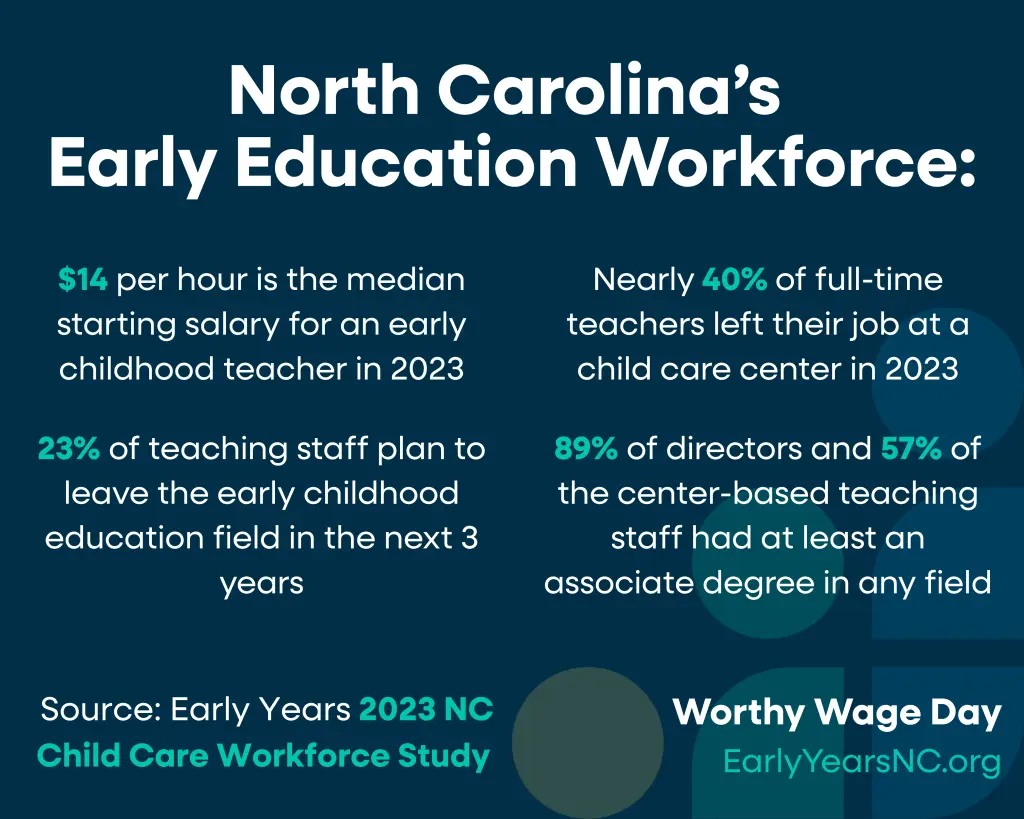
In North Carolina, the living wage for one adult with no children is $22.54 per hour and it is $37.37 for an adult with one child.[2] According to a 2023 workforce study, the median wage for early childhood teachers and assistants in the state is $14.42 an hour.[3] While this rate is an increase from the $12 per hour rate reported in workforce data from 2019, it has not kept pace with inflation. Someone earning $12 per hour in January 2019 would have the buying power of someone earning $14.70 in January 2024.
Without public funding, there is no one solution, no silver bullet. States, and even counties, across the nation continue to seek and implement different strategies to help address the compensation gap for early educators. It will take a combination of many strategies to address this issue, and those that are tied to undercompensation, such as higher turnover rates. One strategy alone likely cannot turn the field around. And child care issues, turnover and absenteeism included, are resulting in a loss of $5.65 billion annually to North Carolina’s economy.[4] This staggering number puts the importance of early childhood in focus and should be a reminder to recognize and support early educators.
Early Years is the home of two salary supplement strategies designed to do exactly that:
-
- The Child Care WAGE$® Program provides education-based salary supplements to eligible educators working with children birth to age five through a collaboration between local Smart Start partnerships who choose to participate, the North Carolina Partnership for Children and the Division of Child Development and Early Education.
-
- Infant-Toddler Educator AWARD$® Plus offers similar supplements to teachers and family child care providers working at least 30 hours per week with children birth through age two. This program is fully funded by the Division of Child Development and Early Education.
Participant compensation is enhanced through the supplements; each payment recognizes their education and is issued only after the completion of a six-month period of time worked in the same facility. Also, those participating in WAGE$ supplements have an average turnover rate of 15%. This turnover rate represents a positive trend, indicating the program’s effectiveness in retaining child care professionals.
These programs alone cannot solve the compensation problem for early educators and are meant to be in combination with the best salaries employers can afford to provide without overburdening parents; [AM1] they work alongside other workforce supports. They are important strategies available to help educators better afford to do the essential work of caring for and educating our young children.
As we recognize Worthy Wage Day on May 1, let’s remember this is more than just numbers. It’s about fairness. It’s about the future. And it’s about recognizing the incredible professionals who do some of the most important work in our communities.
Whether you’re a parent, policymaker, business leader, or simply someone who cares about children, this is your moment to speak up. Let’s celebrate early educators, advocate for better pay, and invest in a system that supports us all.
[1] McLean, C., Austin, L.J.E., Powell, A., Jaggi, S., Kim, Y., Knight, J., Muñoz, S., & Schlieber, M. (2024). Early Childhood Workforce Index – 2024. Center for the Study of Child Care Employment, University of California, Berkeley. https://cscce.berkeley.edu/workforce-index-2024/
[2] Living Wage Calculator, Massachusetts Institute of Technology. https://livingwage.mit.edu
[3] Early Years. 2024. Working in Early Care and Education in North Carolina, 2023 Workforce Study. https://www.earlyyearsnc.org/research/2023-north-carolina-child-care-workforce-study/
[4] US Chamber of Commerce Foundation, NC Chamber Foundation and NC Child. 2024. Untapped Potential in NC: How Childcare Impacts North Carolina’s Workforce Productivity and the State’s Economy. https://ncchamber.com/wp-content/uploads/Untapped_NORTHCAROLINA_053124_DIGITAL.pdf