Blog

Voices from the Classroom: Personal Stories and Insights from North Carolina’s Early Care and Education Workforce
Voices-from-the-Classroom-Carousel-3.png
Share

Hear directly from the people in North Carolina’s classrooms and care centers. 

The Working in Early Care and Education in North Carolina: 2023 Workforce Study is the first of our statewide workforce studies to include a qualitative research component, interviewing teachers, assistant teachers, directors and family child care providers about their personal experiences and recommendations to rebound from the pandemic and strengthen the child care field.

“I don’t know what makes me stay. I do think that if we were treated more like teachers in the public school system and we got the benefits and the respect. I mean, I had a parent come up to me the other day and say: ‘Did you ever not want to be a real teacher?’ and [I] just looked at her and said: ‘I really thought I was.’”

– Teaching Staff, Rural, 4-star

Our research team took special care to ensure that everything from the questions themselves to the experience of being interviewed did not cause participants any harm. As a result, teachers and administrators shared their stories candidly with us.

A few key quotes:

  • “Most of my teachers that are here, they’re very passionate about what they do and they are going to put themselves, how they’re feeling, their own health, on the back burner to be in their classrooms and take care of their children.” – Administrator, Urban, 5-star
  • “I don’t know what makes me stay. I do think that if we were treated more like teachers in the public school system and we got the benefits and the respect. I mean, I had a parent come up to me the other day and say: ‘Did you ever not want to be a real teacher?’ and [I] just looked at her and said: ‘I really thought I was.’”- Teaching Staff, Rural, 4-star
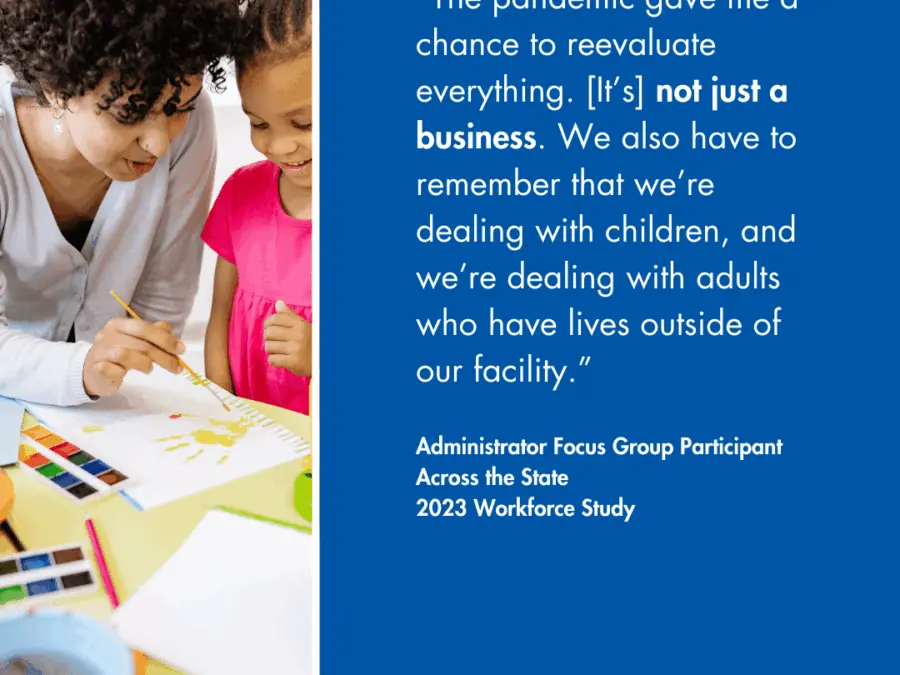
  • “The pandemic gave me a chance to reevaluate everything. [It’s] not just a business. We also have to remember that we’re dealing with children, and we’re dealing with adults who have lives outside of our facility.” – Administrator Focus Group, across the state
  • “I think that embracing the parents as partners in their child’s education was something that we really kind of were forced to do through the pandemic. And I think that it became something that although we wanted to do in the past, we had no choice at this point and we really had to navigate it and make it work in order to keep everybody moving forward to the best of our ability. And I think some parents really benefited from it and I think that some teachers really benefited from it.” – Mixed Administrator, FCC Provider and Teaching Staff Focus Group, across the state

    We are excited about the impact that including this qualitative element in the study could have across the state. 

    “How can we open the eyes of more people and policymakers to see the true picture of the field? Whether you look at it through the eyes of the benefit for the children or the benefit for businesses, something needs to be done because it’s not sustainable,” said Frédérique Yova, Ph.D., the Senior Research Manager at Early Years, formerly known as Child Care Services Association (CCSA). 

    “I think that’s why we were all very excited about adding the qualitative part. Some people are more comfortable with numbers. Other people are more comfortable with stories. So being able to do both, we hope to be able to reach out to more people.”

    Read more stories and experiences from administrators, teachers, assistant teachers, and family child care (FCC) providers in the 2023 Workforce Study.