Resource
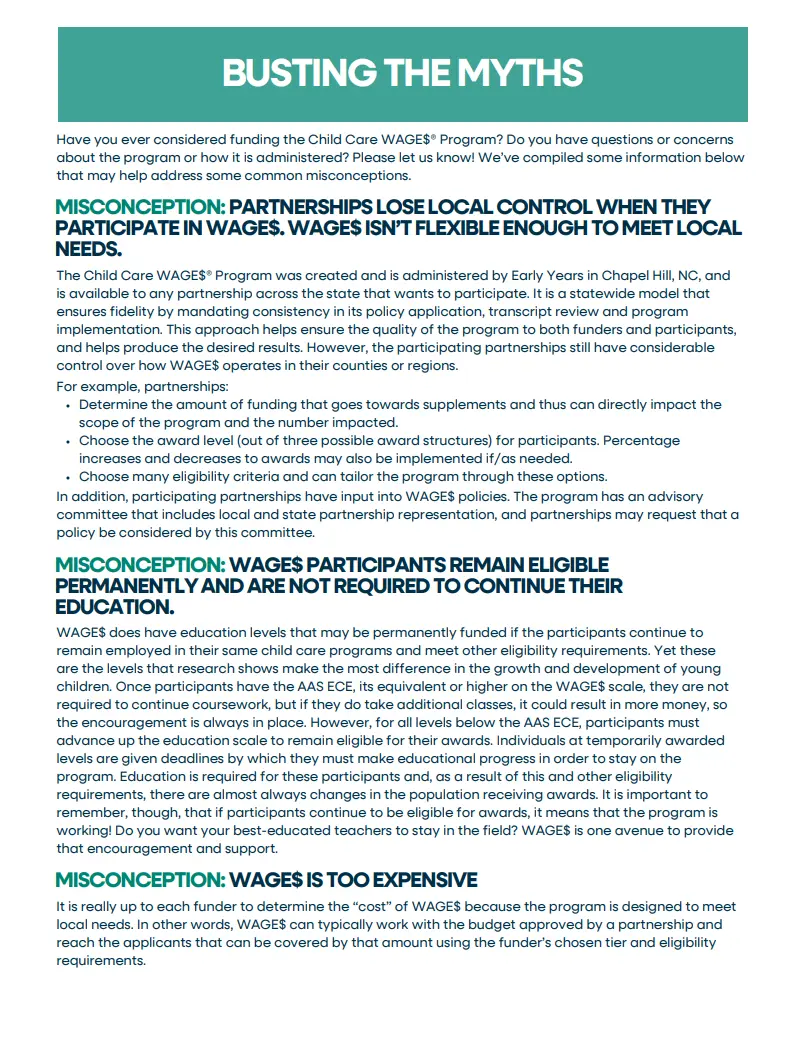
Have you ever considered funding the Child Care WAGE$® Program? Do you have questions or concerns about the program or how it is administered? Please let us know! We’ve compiled some information below that may help address some common misconceptions.
Busting the Myths
The Child Care WAGE$® Program was created and is administered by Early Years in Chapel Hill, NC, and is available to any partnership across the state that wants to participate. It is a statewide model that ensures fidelity by mandating consistency in its policy application, transcript review, and program implementation. This approach helps ensure the quality of the program to both funders and participants and helps produce the desired results. However, the participating partnerships still have considerable control over how WAGE$ operates in their counties or regions.
Misconception: Partnerships lose local control when they participate in WAGE$. WAGE$ isn’t flexible enough to meet local needs.
For example, partnerships:
- Determine the amount of funding that goes toward supplements and thus can directly impact the scope of the program and the number impacted.
- Choose the award level (out of three possible award structures) for participants. Percentage increases or decreases to awards may also be implemented if needed.
- Choose many eligibility criteria and can tailor the program through these options.
In addition, participating partnerships have input into WAGE$ policies. The program has an advisory committee that includes local and state partnership representation, and partnerships may request that a policy be considered by this committee.
Misconception: WAGE$ participants remain permanently eligible and are not required to continue their education.
WAGE$ does have education levels that may be permanently funded if participants remain employed in their same child care programs and continue to meet eligibility requirements. These levels represent the education associated with the greatest impact on young children’s growth and development.
Once participants have the AAS ECE degree, its equivalent, or higher on the WAGE$ scale, they are not required to continue coursework—though doing so may result in higher awards. For all levels below the AAS ECE, participants must advance up the education scale to remain eligible. Individuals at temporarily awarded levels receive deadlines by which they must show educational progress in order to stay on the program.
As a result, the population eligible for awards naturally changes over time. But if participants continue to be eligible, it means the program is working—encouraging well-educated teachers to stay in the field.
Misconception: WAGE$ is too expensive.
Each funder determines the “cost” of WAGE$ because the program is designed to meet local needs. WAGE$ can generally operate within the budget a partnership provides and reach applicants who fit within that funding using the partnership’s chosen tier and eligibility criteria.
With more funding, WAGE$ can reach more individuals and/or provide higher awards. With less funding, the program can be tailored accordingly. WAGE$ will work with partnerships to determine the best strategies based on available resources.
Additionally, when funding WAGE$, partnerships receive a significant benefit: program administration is covered by the Division of Child Development and Early Education (DCDEE).
WAGE$ operates through a collaboration between local Smart Start partnerships that elect to participate, the North Carolina Partnership for Children, and DCDEE. Typically, the entire amount a partnership allocates goes directly to salary supplements in the communities it represents—directly into the hands of participants. Because WAGE$ is administered statewide by Early Years, partnerships also save substantial money and staff time on local administration and evaluation.
Related Resources
View All
Resource


